Salesforce alternative for enterprise: Top 7 Powerful Salesforce Alternative for Enterprise in 2024

Looking for a smarter, more scalable way to manage enterprise relationships? Discover the most powerful Salesforce alternative for enterprise that delivers flexibility, innovation, and cost-efficiency without compromise.
Why Enterprises Are Seeking a Salesforce Alternative for Enterprise

While Salesforce has long dominated the CRM landscape, many large organizations are now actively exploring a Salesforce alternative for enterprise environments. The reasons are multifaceted—ranging from escalating licensing costs to complexity in customization and integration challenges. As digital transformation accelerates, enterprises demand platforms that are not only robust but also agile, cost-effective, and aligned with modern business workflows.

Rising Costs of Salesforce Licensing
One of the primary drivers pushing enterprises toward a Salesforce alternative for enterprise is the steep pricing model. Salesforce’s enterprise editions—particularly Unlimited and Enterprise tiers—can cost thousands of dollars per user annually. For organizations with hundreds or thousands of users, this quickly becomes a multi-million dollar annual expense.
According to Gartner Peer Insights, many large companies report that total cost of ownership (TCO) for Salesforce often exceeds initial estimates due to add-ons, custom development, and third-party integrations. This has led CFOs and IT leaders to reevaluate whether the ROI justifies the investment.
- Annual licensing fees per user can exceed $300/month
- Additional costs for Sandboxes, API calls, and storage
- Hidden expenses from consultants and implementation partners
Complexity and Customization Challenges
While Salesforce offers extensive customization through its Lightning Platform and Apex coding, this flexibility often comes at the cost of complexity. Enterprises frequently report that even minor changes require developer intervention, slowing down business agility.
Moreover, the learning curve for administrators and end-users is steep. Training programs, ongoing support, and governance frameworks are necessary to maintain system integrity—adding to operational overhead. This complexity makes a Salesforce alternative for enterprise increasingly appealing, especially for organizations seeking low-code or no-code adaptability.
“We spent 18 months and over $2M just to customize Salesforce for our global sales teams. We’re now migrating to a more intuitive platform.” — CIO, Fortune 500 Manufacturing Firm
Key Features to Look for in a Salesforce Alternative for Enterprise
Choosing the right Salesforce alternative for enterprise isn’t just about replacing a CRM—it’s about future-proofing your customer engagement strategy. Enterprises must evaluate platforms based on scalability, integration capabilities, AI readiness, and user experience. The best alternatives offer enterprise-grade security, global compliance, and seamless data migration paths.
Scalability and Global Deployment
Enterprises operate across regions, time zones, and regulatory environments. A viable Salesforce alternative for enterprise must support multi-geo deployments with localized data residency and language support. Cloud-native architecture is essential for handling high-volume transactions and concurrent users without performance degradation.
Platforms like Microsoft Dynamics 365 and Oracle CX Cloud are built with global scalability in mind, offering data centers across North America, EMEA, and APAC. This ensures low-latency access and compliance with GDPR, CCPA, and other regional regulations.
- Support for multi-currency, multi-language, and multi-tenant environments
- Auto-scaling infrastructure to handle peak loads
- Global data center presence for compliance and performance
Integration and API Ecosystem
No CRM operates in isolation. A top-tier Salesforce alternative for enterprise must offer robust integration capabilities with ERP systems (like SAP or Oracle), marketing automation tools (such as Marketo or HubSpot), and collaboration platforms like Microsoft Teams or Slack.
Modern platforms leverage RESTful APIs, pre-built connectors, and iPaaS (integration Platform as a Service) support to streamline data flow. For example, Microsoft Dynamics 365 integrates natively with Azure Logic Apps and Power Automate, enabling enterprises to build complex workflows without coding.
“The ability to sync CRM data with our SAP S/4HANA in real time was a game-changer. It eliminated manual data entry and reduced errors by 70%.” — VP of Operations, Global Logistics Company
Top 7 Salesforce Alternatives for Enterprise in 2024
The market for enterprise CRM solutions has matured significantly, offering powerful alternatives to Salesforce that combine deep functionality with better usability and lower TCO. Below are the top 7 Salesforce alternative for enterprise platforms that are gaining traction among large organizations.
1. Microsoft Dynamics 365
Microsoft Dynamics 365 stands out as one of the most compelling Salesforce alternative for enterprise due to its deep integration with the Microsoft ecosystem. It combines CRM and ERP functionalities, making it ideal for organizations already using Office 365, Azure, and Power BI.
Dynamics 365 offers modules for sales, customer service, field service, marketing, and finance—all built on a unified data model. Its AI-powered insights, powered by Azure AI, help predict customer churn, recommend next-best actions, and automate routine tasks.
- Seamless integration with Outlook, Teams, and SharePoint
- AI-driven sales forecasting and customer insights
- Flexible licensing models with pay-as-you-go options
According to Forrester Research, enterprises using Dynamics 365 report a 30% faster time-to-value compared to Salesforce implementations.
2. Oracle CX Cloud Suite
Oracle CX Cloud is a comprehensive Salesforce alternative for enterprise that excels in industries like financial services, telecommunications, and healthcare. It offers end-to-end customer experience management, from marketing and sales to service and loyalty.
What sets Oracle apart is its embedded AI and machine learning capabilities across all modules. Oracle Adaptive Intelligence delivers real-time recommendations, fraud detection, and sentiment analysis—powered by one of the largest enterprise data lakes in the world.
- Unified B2B and B2C commerce capabilities
- Advanced analytics with Oracle Analytics Cloud
- Strong support for CPQ (Configure, Price, Quote) and contract management
Oracle’s acquisition of Cerner has further strengthened its position in regulated industries, making it a trusted Salesforce alternative for enterprise with strict compliance needs.
3. SAP Customer Experience (SAP CX)
SAP Customer Experience is a natural choice for enterprises already invested in SAP ERP systems. As a Salesforce alternative for enterprise, SAP CX offers deep integration with SAP S/4HANA, enabling real-time synchronization of customer, product, and financial data.
The suite includes SAP Sales Cloud, Service Cloud, Marketing Cloud, and Commerce Cloud. It’s particularly strong in complex sales environments, such as industrial manufacturing and wholesale distribution, where pricing and configuration are highly intricate.
- Tight integration with SAP ERP and supply chain systems
- Advanced CPQ with rule-based pricing and bundling
- Global scalability with support for 40+ languages
A case study from SAP highlights a global automotive supplier that reduced quote-to-cash cycle time by 40% after migrating from Salesforce to SAP Sales Cloud.
4. HubSpot Enterprise
Once seen as a solution for SMBs, HubSpot has evolved into a credible Salesforce alternative for enterprise with its Enterprise tier. It offers a user-friendly interface, powerful automation, and a growing ecosystem of integrations.
HubSpot’s strength lies in its all-in-one platform approach—combining CRM, marketing, sales, service, and content management. Its drag-and-drop workflows, intuitive reporting, and AI-powered content suggestions make it ideal for marketing-heavy enterprises.
- No-code automation builder for marketing and sales
- AI-powered content generation and SEO recommendations
- Custom objects and granular permission controls for enterprise governance
While HubSpot may not match Salesforce in complex customization, its ease of use and rapid deployment make it a top choice for enterprises prioritizing agility over deep technical control.
5. Zoho CRM Plus (with Zia AI)
Zoho CRM Plus is an underrated but powerful Salesforce alternative for enterprise, especially for organizations looking to consolidate multiple business functions into a single platform. It includes CRM, marketing automation, sales force automation, customer support, and inventory management.
Zia, Zoho’s AI assistant, provides predictive lead scoring, sentiment analysis, and voice-based data entry. The platform is highly customizable with Zoho Creator and Deluge scripting, allowing enterprises to build custom apps without leaving the ecosystem.
- One of the lowest TCOs among enterprise CRMs
- Over 50 pre-built connectors to third-party apps
- Strong data privacy with on-premise deployment options
According to Zoho’s customer stories, a multinational pharmaceutical company reduced its CRM costs by 60% while improving data accuracy after switching from Salesforce to Zoho CRM Plus.
6. Pipedrive Enterprise
Pipedrive, traditionally known for its sales pipeline focus, has expanded into the enterprise space with its Enterprise plan. It’s a streamlined Salesforce alternative for enterprise that emphasizes sales process clarity and team productivity.
The platform’s visual pipeline interface helps sales teams track deals with minimal friction. Advanced features like workflow automation, multi-level permissions, and API access make it suitable for larger organizations.
- Intuitive drag-and-drop pipeline management
- Real-time sales forecasting and performance dashboards
- Integration with Google Workspace, Microsoft 365, and Slack
While Pipedrive lacks the breadth of Salesforce’s service and marketing modules, it excels in sales execution—making it ideal for enterprises with a sales-first strategy.
7. Freshworks Freshteam & Freshsales
Freshworks offers a modular Salesforce alternative for enterprise through its Freshsales and Freshteam platforms. Freshsales is a full-featured CRM with AI-driven insights, while Freshteam handles HR and employee engagement—ideal for organizations focused on internal customer experience.
Freshsales includes built-in phone, email, and chat, along with AI-based lead scoring and conversation intelligence. Its flat pricing model (per user, unlimited features) contrasts sharply with Salesforce’s tiered, feature-gated approach.
- AI-powered sales assistant for call transcription and insights
- Integrated phone and video calling within the CRM
- Transparent, predictable pricing with no hidden fees
A Freshworks case study reveals that a global IT services firm reduced onboarding time for new sales reps from 6 weeks to 10 days using Freshsales.
Comparative Analysis: Salesforce vs Top Alternatives
To help enterprises make an informed decision, here’s a comparative analysis of Salesforce and leading Salesforce alternative for enterprise platforms across key dimensions.
Cost and Licensing Models
Salesforce operates on a tiered licensing model where advanced features are locked behind higher-priced editions. In contrast, many alternatives offer flat-rate pricing with all features included.
- Salesforce: $25–$300+/user/month depending on edition
- Dynamics 365: $65–$225/user/month with bundled Office 365 benefits
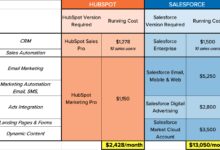
- HubSpot Enterprise: $1,200/month for 10 users (~$120/user)
- Zoho CRM Plus: $52/user/month (billed annually) with all features
- Freshsales: $99/user/month (Enterprise plan) with unlimited features
Enterprises report saving 30–60% on annual CRM costs by switching to a Salesforce alternative for enterprise, especially when factoring in reduced consulting and customization expenses.
Implementation Time and User Adoption
Salesforce implementations often take 6–12 months for large enterprises, requiring dedicated project teams and external consultants. Alternatives like HubSpot and Zoho can be deployed in weeks, thanks to intuitive interfaces and pre-built templates.
User adoption is another critical factor. Platforms with consumer-grade UX—such as HubSpot and Freshsales—see faster onboarding and higher engagement rates. A Nucleus Research report found that user adoption rates for Salesforce average 68%, while HubSpot and Dynamics 365 achieve 85% and 80%, respectively.
“We went live with Zoho CRM Plus in 8 weeks. With Salesforce, our previous implementation took 9 months and cost $1.2M.” — IT Director, Midsize Enterprise
Data Migration and Integration Strategies
Migrating from Salesforce to another platform is a significant undertaking, but it’s far from impossible. A successful transition requires careful planning, data cleansing, and phased rollouts. The right Salesforce alternative for enterprise should offer robust data import tools and API access to ensure minimal disruption.
Steps for Smooth Data Migration
Data migration is often the most complex part of switching CRMs. Here’s a proven framework for moving from Salesforce to a new platform:
- Assessment: Audit existing data—identify duplicates, outdated records, and unused fields.
- Mapping: Define how Salesforce objects (Leads, Accounts, Opportunities) map to the new system.
- Extraction: Use Salesforce Data Export or APIs to extract clean data.
- Transformation: Normalize data formats (e.g., date, currency) to match the target system.
- Load: Import data using CSV, API, or migration tools like Mover.io or Talend.
- Validation: Run reconciliation reports to ensure data integrity.
Many vendors, including Zoho and Freshworks, offer free migration services for enterprise customers—reducing the burden on internal IT teams.
Integration with Legacy Systems
Enterprises often rely on legacy ERP, HR, and finance systems. A viable Salesforce alternative for enterprise must support secure, real-time integration. Look for platforms that offer:
- Native connectors for SAP, Oracle, and Microsoft Dynamics
- Support for SSO (Single Sign-On) via SAML or OAuth
- Webhooks and event-driven APIs for custom integrations
- Compliance with SOC 2, ISO 27001, and GDPR
For example, Microsoft Dynamics 365 integrates natively with Azure Active Directory and supports hybrid deployments—making it ideal for enterprises with on-premise infrastructure.
Future Trends Shaping Enterprise CRM
The CRM landscape is evolving rapidly, driven by AI, automation, and changing customer expectations. Enterprises evaluating a Salesforce alternative for enterprise must consider not just current needs but also future readiness.
AI and Predictive Analytics
AI is no longer a nice-to-have—it’s a core requirement. The next generation of CRM platforms uses AI for predictive lead scoring, sentiment analysis, and automated follow-ups. Salesforce Einstein was an early mover, but competitors like Microsoft Copilot, Zia, and HubSpot’s Content Assistant are catching up fast.
Enterprises should prioritize platforms with embedded AI that requires minimal training and delivers actionable insights without data science expertise.
No-Code and Low-Code Customization
Business users are increasingly taking ownership of CRM customization. Platforms that offer drag-and-drop workflow builders, form designers, and automation tools empower non-technical teams to innovate without IT bottlenecks.
HubSpot’s Operations Hub, Zoho’s Flow, and Microsoft Power Automate are examples of low-code tools that enhance agility. A Salesforce alternative for enterprise that supports citizen development will future-proof your organization against dependency on developers.
Vertical-Specific Solutions
Generic CRM platforms are giving way to industry-specific solutions. For example, Veeva for life sciences, Salesforce Financial Services Cloud, and Oracle CX for retail. Enterprises should evaluate whether a Salesforce alternative for enterprise offers tailored workflows, compliance templates, and industry integrations.
“We chose Oracle CX over Salesforce because it had pre-built compliance workflows for HIPAA and GDPR—saving us 6 months of development.” — CISO, Healthcare Provider
FAQ
What is the best Salesforce alternative for enterprise with AI capabilities?
Microsoft Dynamics 365 and Oracle CX Cloud are leaders in AI-powered CRM. Both offer embedded machine learning for sales forecasting, customer segmentation, and service automation. Dynamics 365 integrates with Azure AI, while Oracle leverages its vast enterprise data network for adaptive intelligence.
Can HubSpot really replace Salesforce in large enterprises?
Yes, HubSpot’s Enterprise plan is designed for large organizations with advanced needs. It supports custom objects, granular permissions, API access, and enterprise-grade security. While it may not match Salesforce in complex customization, its ease of use and rapid deployment make it ideal for agile enterprises.
How much can enterprises save by switching to a Salesforce alternative?
Enterprises typically save 30–60% on annual CRM costs by switching to alternatives like Zoho, Freshworks, or Dynamics 365. Savings come from lower licensing fees, reduced consulting costs, and faster implementation timelines.
Is data migration from Salesforce difficult?
Migration can be complex, but it’s manageable with the right tools and planning. Most top alternatives offer free migration services, pre-built connectors, and data validation tools. Using platforms like Mover.io or Talend can automate much of the process.
Which Salesforce alternative for enterprise is best for global companies?
Microsoft Dynamics 365 and SAP CX are top choices for global enterprises due to their multi-region data centers, multi-language support, and compliance with international regulations like GDPR and CCPA.
Choosing the right Salesforce alternative for enterprise is a strategic decision that impacts sales efficiency, customer experience, and operational costs. While Salesforce remains a powerful platform, its complexity and cost are driving enterprises toward more agile, integrated, and cost-effective solutions. From Microsoft Dynamics 365 to Zoho CRM Plus, the alternatives offer compelling benefits—from AI-driven insights to faster deployment and lower TCO. The key is aligning your CRM choice with your business goals, industry needs, and digital transformation roadmap. By evaluating scalability, integration, and future readiness, enterprises can find a Salesforce alternative for enterprise that not only replaces but elevates their customer engagement strategy.
Further Reading: